



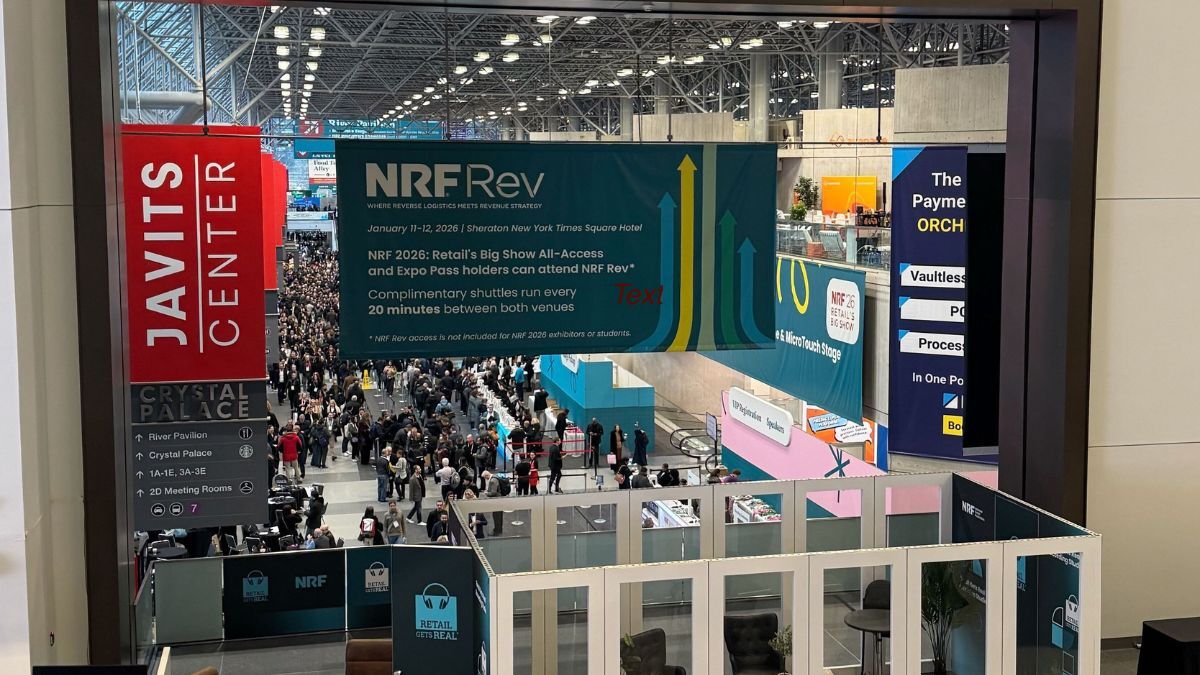
The challenge is therefore not to copy retail, but to translate proven patterns into a B2B reality defined by complexity, scale and long-term customer relationships.
This article summarizes some signals from NRF 2026 that are most relevant for B2B commerce and why they matter.
1. AI is becoming part of daily work, not just the experience
AI was present everywhere at NRF, but the tone has changed. There were fewer futuristic demos and more focus on how AI is actually used in day-to-day work.
Much of the attention was on AI supporting internal processes: content creation, service, forecasting, decision support and operational efficiency.
In retail-like B2B environments, value is rarely created through visual experiences alone. It is created through accuracy, speed and reduced manual work across complex processes. AI has the biggest impact when it helps teams handle scale, variation and complexity more efficiently.
This means AI should be introduced where it removes friction — not where it adds layers of abstraction. Practical use cases matter more than impressive demos.
2. Discovery and decision are moving closer together
Several sessions focused on how discovery is changing. Search is becoming more conversational, more visual and more context-aware. Buyers expect faster answers and fewer steps before they can make a decision.
This shift is often described in a retail context, but the underlying behavior is already visible in B2B buying journeys.
In wholesale, distribution and manufacturing, buyers want to qualify options quickly and understand what applies to their specific situation. They expect clear, relevant answers - not more content.
This puts pressure on how product information, pricing logic, availability and documentation are structured and connected. As a result, product data becomes a strategic asset. Without reliable and well-structured data, improved discovery does not work.

3. Execution matters more than which platform you choose
Compared to previous years, there was less debate about platforms and architectures. Instead, the focus shifted toward how organizations actually operate across systems, partners and teams.
Technology remains important, but it is no longer the main differentiator.
Most B2B commerce landscapes are already complex. Multiple systems, customer-specific rules, integrations and legacy processes are common, especially in distribution and manufacturing.
Adding new platforms without clear ownership and well-defined processes often increases complexity rather than reducing it. What ultimately creates value is how solutions are designed, implemented, and evolved on top of the platform.
NRF 2026 reinforced a familiar reality: in B2B, execution quality and operational structure matter more than technical flexibility.
4. Data quality is a basic requirement, not a side topic
Data was rarely the headline topic on stage, but it was always present in the background. AI, automation, personalization and real-time services all assume structured and trustworthy data.
Without it, progress stalls.
B2B data is inherently complex. Product structures are deeper, assortments are customer-specific, pricing is contractual and regulatory requirements are often part of the equation.
This makes investments in PIM, MDM, integrations and data governance fundamental, not optional. Poor data quality does not just slow initiatives down; it limits what the organization can realistically achieve at scale.
5. Trust and consistency matter more than new ideas
Some of the strongest messages at NRF had little to do with technology. They focused on staying close to customers, being honest and delivering consistently over time.
The message was clear: long-term success comes from doing the basics well, every day.
B2B buyers are cautious by default. They trust experience, references and proven delivery more than promises or messaging. Brand is built through execution, reliability and transparency.
In wholesale, distribution and manufacturing, credibility is earned operationally - not through novelty.
What this means for retail-like B2B commerce
NRF 2026 did not introduce a bunch of radically new ideas for B2B. Instead, it reinforced directions that many retail-like B2B organizations are already moving in:
- Focus on operational value before polished experiences
- Treat product and customer data as strategic assets
- Focus on execution and operating models, not just platform choice
- Use AI where it simplifies work and improves decisions
- Build trust through consistent delivery
The common theme is pragmatism - applied to complex B2B realities.
Translation beats replication
NRF is increasingly reflecting challenges and opportunities that are already familiar in wholesale, distribution and manufacturing, where digital commerce is expected to combine scale, efficiency and customer relevance.
Success does not come from copying retail. It comes from translating retail-proven ideas into B2B-ready solutions, grounded in data quality, operational discipline and long-term relationships.
Retail has long served as an early indicator. Competitive advantage comes from knowing how - and when - to adapt those signals.
The companies that succeed will not be the ones that move fastest, but the ones that move deliberately and get the fundamentals right.
Want to dive deeper into what trends are shaping B2B commerce right now? Contact us to set up a meeting, and we'll get back to you as soon as possible.