



For retailers, meeting these customer expectations is both an opportunity and an operational challenge. As sales channels, inventory locations and fulfillment options multiply, delivering a seamless omnichannel experience becomes increasingly complex.
So, what do omnichannel customers actually expect? How mature is your omnichannel offering? And what role does an Order Management System (OMS) play in turning customer expectations into reality?
Why Omnichannel Matters for Retailers
Omnichannel is about more than offering customers multiple ways to shop. More importantly, retailers should focus on making those channels work together so customers can move between them without friction.
And the commercial potential is significant. Research figures suggest that:
-
68% of consumers are channel-agnostic, moving between channels rather than committing to one.*
-
Omnichannel shoppers spend 73% more than customers shopping through a single channel.*
-
Retailers showcasing local inventory and pickup options can see a 21% increase in store visits and a 9% increase in online conversions.*
While the exact impact varies between retailers, these figures illustrate an important point: Connecting digital and physical shopping experiences can influence both customer behavior and business performance.
Simply showing customers that a product is available at a nearby store can encourage them to visit. Offering a convenient pickup option can help turn browsing into a purchase. But the opportunity depends on retailers being able to deliver what they promise.
What Omnichannel Customers Actually Want
Customers rarely ask for an omnichannel experience. Instead, they have practical expectations that retailers need to meet.
Here are five capabilities that make a difference throughout the shopping journey.
1. Real-Time Inventory Visibility
Is the product available at my local store? Can I pick it up today? If it's only available online, when will it arrive?
Customers want accurate product availability before deciding where and how to buy. Displaying inventory across stores and warehouses helps customers make informed purchasing decisions. But the information must be reliable. Showing a product as available when it has already been sold can quickly undermine trust.
2. Click & Reserve
Can I reserve the product online and try it in-store before deciding whether to buy?
Click & Reserve gives customers the convenience of online browsing with the reassurance of a physical shopping experience. The challenge is ensuring that reserved products are actually set aside and available when customers arrive. This requires coordination between online channels, inventory information and store employees.
3. Click & Collect
Can I buy the product online and pick it up on my way home from work? Will it be ready when I arrive? Click & Collect combines the convenience of online purchasing with the speed and flexibility of physical stores. For customers, the process should feel simple. Behind the scenes, retailers need reliable inventory updates, efficient picking processes and clear communication about when orders are ready for collection.
4. Ship from Store
My preferred size or color is sold out online. Can you deliver it from one of your stores instead?
Traditionally, online orders have been fulfilled from warehouses or distribution centers. But what happens when a product is unavailable there while several units remain in physical stores? Ship from Store allows retailers to use store inventory to fulfill online orders, potentially increasing product availability and reducing missed sales opportunities.
5. Endless Aisle
The product isn't available in my local store. Can the staff help me order it from another location?
Endless Aisle allows store employees to sell products beyond what's physically available in their store. By accessing inventory across other stores and warehouses, employees can help customers complete their purchases rather than sending them elsewhere. Together, these capabilities make shopping more convenient. But they also require retailers to coordinate inventory, orders and fulfillment across an increasingly complex network.
The Omnichannel Maturity Model: From Hygiene to Great
Most retailers already offer some level of omnichannel functionality. The question is how far those capabilities extend and how well they work together.
A useful way to evaluate omnichannel maturity is through three levels: Hygiene, Good and Great. Each level introduces new opportunities for customer experience and operational efficiency, but also greater requirements for data accuracy, internal processes and technology.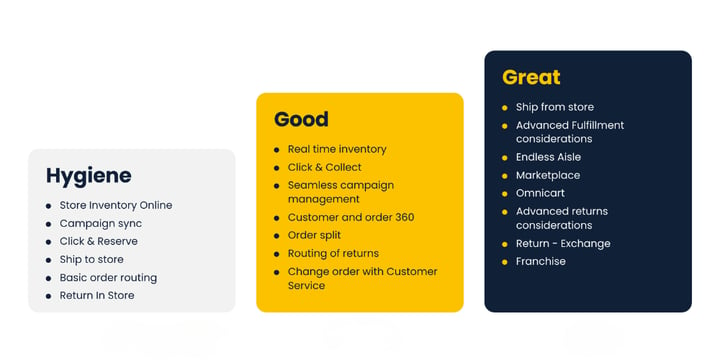
Hygiene: Getting the Basics Right
At the first level, retailers establish essential connections between online and physical shopping.
Typical capabilities include:
-
Displaying store inventory online
-
Synchronizing campaigns and pricing across channels
-
Offering Click & Reserve
-
Accepting online returns in physical stores
These capabilities make it easier for customers to interact with a retailer across channels. For many retailers, they can be supported by existing ERP or e-commerce systems without introducing a dedicated OMS. However, having these features in place doesn't necessarily mean that inventory information is updated in real time or that orders can be managed flexibly across the entire retail network. As omnichannel sales grow, these limitations can become increasingly noticeable.
Good: Connecting the Customer Journey
The second level focuses on making omnichannel experiences more consistent, reliable and operationally efficient.
Typical capabilities include:
-
Real-time inventory visibility across channels
-
Click & Collect
-
Seamless campaign management
-
A unified view of customers and orders
-
Order splitting across fulfillment locations
-
Intelligent routing of returns
-
Allowing customer service to modify existing orders
At this stage, retailers move beyond simply connecting channels. They begin coordinating inventory and orders across the business. Consider a customer who purchases three products online. One is available in the central warehouse, while the other two are stocked in different stores. Instead of treating this as an exception requiring manual intervention, the retailer can determine how the order should be fulfilled based on availability, delivery promises and operational considerations.
This is also where many retailers begin to experience the limitations of managing order processes primarily through an ERP or e-commerce platform. These systems remain essential, but increasingly complex fulfillment requirements may call for specialized order management capabilities.
Great: Making the Entire Retail Network Available
The third level is about using the full potential of a retailer's inventory, sales channels and fulfillment network.
Advanced capabilities include:
-
Ship from Store
-
Advanced fulfillment optimization
-
Endless Aisle
-
Marketplace order management
-
Omnicart, enabling shopping journeys across channels
-
Advanced returns management
-
Returns and exchanges across channels
-
Support for franchise operations
At this level, retailers can make more sophisticated decisions about how and where orders should be fulfilled. For example, when a product is available in several locations, the best fulfillment option may not simply be the closest warehouse. It could be a store holding excess inventory, a distribution center with lower handling costs or a location that can meet the customer's delivery expectations more efficiently. The goal is to balance customer convenience with operational efficiency and profitability.
Reaching this level requires more than adding new customer-facing features. Retailers need accurate data, well-defined processes and technology that can coordinate decisions across the entire fulfillment network.
How an OMS Helps Retailers Deliver on the Omnichannel Promise
As retailers progress through the maturity levels, the number of decisions involved in fulfilling each order increases. Orders may arrive through websites, stores, marketplaces, apps or other sales channels. Inventory may be distributed across warehouses, stores and suppliers. Customers may choose home delivery, Click & Collect or other fulfillment options.
Managing these combinations becomes difficult when each system operates independently. This is where an Order Management System (OMS) plays an important role. An OMS coordinates orders, inventory availability and fulfillment processes across sales channels and inventory locations. It helps retailers determine what can be sold, where orders should be fulfilled and how order information should be communicated throughout the customer journey.
The value of an OMS extends beyond operational efficiency. These are some benefits omnichannel retailers can expect:
-
Improved customer experience and conversion: Accurate inventory information, reliable delivery promises and flexible delivery options help remove friction in the buying journey.
-
Increased customer satisfaction: Better communication through timely order confirmations, status updates and proactive communication when something changes.
-
Better use of available inventory: By making inventory available across channels and warehouses, retailers can reduce missed sales opportunities, improve inventory turnover and limit unnecessary stock accumulation.
-
Empower store and customer service staff: With a complete view of products, availability and orders, employees can provide better service across customer touchpoints.
-
Reduce operational costs and complexity: More fulfillment options don't automatically mean better profitability. Configurable fulfillment rules can help retailers balance delivery speed, inventory availability and fulfillment costs.
Is Your Omnichannel Strategy Outgrowing Your Systems?
Not every retailer needs a dedicated OMS from day one. For businesses with relatively simple order flows, limited inventory locations and few fulfillment options, existing systems may provide sufficient support.
But as omnichannel operations expand, certain challenges can indicate that the current setup is becoming a limitation. Common signs include inaccurate inventory information, manual workarounds in order processing, difficulty introducing new fulfillment options and growing complexity between ERP, e-commerce and store systems.
Another important consideration is flexibility. Customer expectations will continue to evolve, and retailers need to be able to introduce new channels, fulfillment methods and services without rebuilding their entire order management setup.
The Omnichannel Maturity Model above provides a useful starting point for understanding where your business stands today and what capabilities could create value next. An OMS can become an important part of that journey, helping retailers connect channels, make better use of inventory and manage increasingly complex fulfillment operations.
Ultimately, the goal isn't to offer as many omnichannel features as possible. It's to deliver the right customer experience while maintaining control over the cost and complexity of fulfilling every order.
In collaboration with: