



When everyone can build fast, what sets you apart is how your brand is experienced: how it looks, feels and works in every interaction. Design and UX are becoming increasingly important competitive advantages. Together with a distinctive brand, they help create experiences that AI alone cannot deliver.
AI creates interfaces from whatever we give it. Just as a good prompt is key to getting good results from AI, so is a good design system. Give it one, and it can build on-brand, accessible and consistent experiences at scale. Give it creative freedom or unclear instructions, and you get generic output, a fragmented brand and code that becomes hard to maintain.
Brand, design, UI and UX have moved from being a finishing layer to the foundation for AI to build on.
AI Makes Everything Look the Same, Unless Design Leads
Generative AI learns from existing patterns, which means that without clear direction, it often produces generic results. Ask a handful of tools for a product page and you often get variations of the same layout, the same gradients and the same tone of voice.
For brands, that is a real business risk. What people remember are the things that are unmistakably yours: a color, a shape, a typeface, a way of speaking. If those assets are shared with everyone else, they stop working. And when we let AI make the choices, it pulls everything toward the middle.
We expect the gap between brands that design deliberately and brands that let tools decide to grow quickly. When more companies use the same tools, standing out takes conscious design choices. Being distinctive will get harder, and therefore more valuable.
Brand Comes First
A design system can only carry what you put into it. Without a clear brand idea, even the best system just produces consistent sameness.
Before tokens and components comes a different kind of work: knowing what you stand for, how you want people to feel and how you sound. It’s important to remember that AI can help you produce more but it cannot decide who you are.
The strongest brands will treat their brand and design system as one. The brand is the idea. The design system is how that idea reaches every screen, every channel and every feature.
How Design Systems Keep AI on Brand
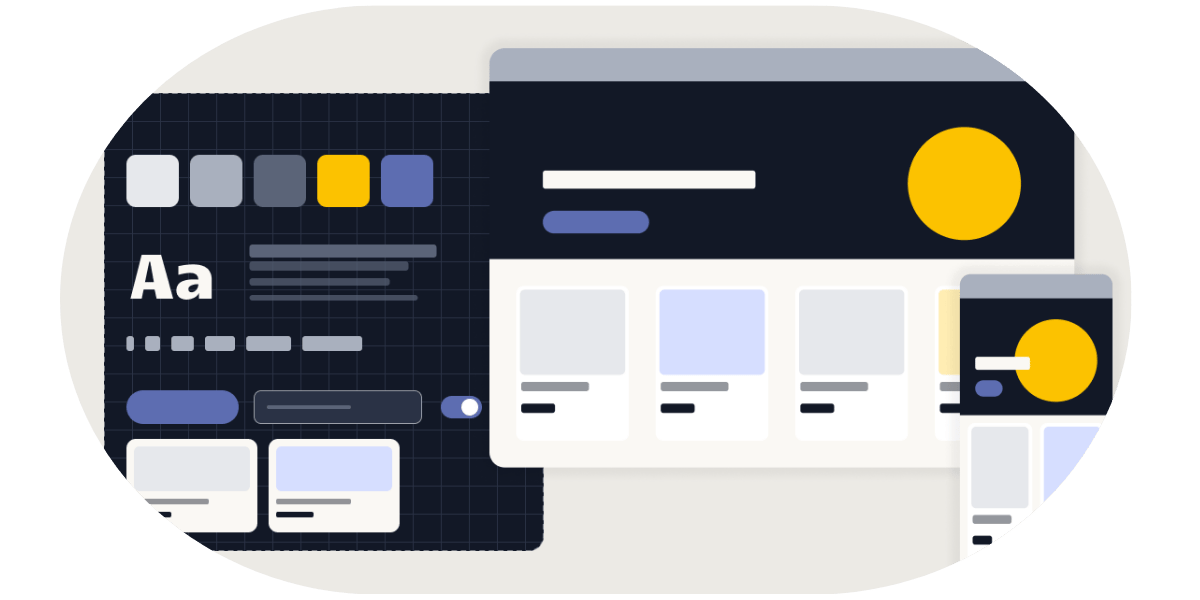
The design system is where your brand stops being guidelines and becomes something AI can actually use.
Today, a substantial amount of code is being written by AI agents, so the quality of your design system increasingly sets the quality of what AI produces on your behalf.
A design system that machines can read gives agents clear building blocks: tokens for color, type and spacing, components with defined rules, and documented reasons for how things should behave. Teams that invest in this kind of structure tend to get far more consistent, predictable results from AI. Often, AI is simply handed a link to a design file and asked to build from it. That makes a well-structured file more than good practice for designers. It is an instruction manual for AI.
On the other hand, without a solid foundation, things quickly fall apart. When AI builds features separately for each flow, product or channel, there is a high risk of fragmenting the experience. Each piece might be fine on it’s own, but together they lack coherence and the brand loses recognition. Customers move between web, app, store and chat, often within the same buying journey. Each touchpoint is a chance to build recognition, or to break it.
AI does not create this problem, but it makes it happen much faster and at a larger scale, even for a single small team. A shared design system is the guardrail that keeps every interaction recognizably yours.
Designing for People and AI Agents
Customers are no longer the only ones looking at your products. AI agents increasingly search, compare and recommend on their behalf, and soon many will buy for them too.
AI agents don't evaluate products in quite the same way people do. A well-known brand may get an edge when everything else is equal, but that edge seems to fade quickly when a competitor offers clearer information or stronger evidence. Depending on how an agent processes visual information, product imagery can matter too.
Design therefore needs to work for both audiences:
-
For people: a brand experience they recognize instantly, that feels effortless and that they want to come back to.
-
For agents: clear structure, consistent product data and imagery that is easy to interpret.
Accessibility is one area where the needs of people and AI agents overlap. Clear structure and semantic code improve accessibility for people and can also make digital content easier for AI systems to interpret. With agentic commerce on the rise, accessibility deserves attention beyond compliance. It helps create better experiences for people while supporting the technical clarity that AI systems increasingly depend on.
A brand can look great to people and still be difficult for AI agents to interpret. If your product information is unclear or inaccessible, you risk being overlooked.
Craft and Consistency Build Trust
As AI-generated content becomes the norm, people are becoming more aware of it, and they are not always impressed. There are signs that when people learn something was made with AI, the brand can feel less authentic. AI-generated images of people in ads seem to be a particular turn-off. The point is not to avoid AI, but to make sure that the outcome never feels generic.
Two things matter especially here:
-
Craft. Visible care and attention to detail signal authenticity and show that real people stand behind the experience.
-
Consistency. A predictable experience across every touchpoint creates familiarity, which in turn builds trust and loyalty.
People notice when care has gone into an experience. AI can generate a lot, but it takes deliberate design to create something people trust.
Built for Change
Markets, technology and customer behavior are changing fast, and few companies can plan far ahead. In that situation, a strong design foundation is less about polish and more about resilience: staying on brand and being able to adapt.
-
Efficiency. Mature design systems help teams save time. Less rebuilding, less duplication and faster delivery free up capacity for improving customer experiences and solving business challenges.
-
Adaptability. A well-built design system lets you respond quickly when things change, whether that means a new market, a new channel or a new generation of AI tools.
Design is not a cost to cut when times get tough. It is part of what keeps your brand recognizable and your teams able to move.
Five Questions Worth Asking
AI will keep making creation faster and cheaper. The companies that stand out will be those that treat brand, design, UI and UX as strategic infrastructure, not decoration. If you lead a digital business, these are good questions to start with:
-
Do we know what we stand for? Is our brand idea clear enough to guide both people and AI, and are our most distinctive assets curated in our design system?
-
Can AI build on our brand? If a coding agent built a new feature from our design files tomorrow, would it look, feel and work like us?
-
Can AI agents understand us? Are our product information, structure and imagery clear enough for agents that search and shop on behalf of our customers?
-
Where do we show craft and care? And where are we open about our use of AI?
-
Is accessibility built in? Are our components accessible by default, so every experience works for people and machines alike?
AI will play a growing role in creating your brand experiences. Make sure it has something worth building from.