



Supply chain management is built around planning. Businesses forecast demand, optimize inventory and coordinate replenishment to make sure the right products are available in the right place at the right time. Yet even the best planning cannot account for every shift in supply, demand or the wider market.
A product can suddenly go viral on social media. Transportation lead times can increase because of geopolitical disruption. New tariffs can change sourcing economics almost overnight. A supplier can fail to deliver, while demand remains exactly where you expected it to be.
You cannot build an accurate forecast for every event that might happen. What you can build is a supply chain capable of responding when it does.
What Does Supply Chain Resilience Actually Mean?
Resilience is sometimes discussed in terms of risk management or contingency planning. But from an operational supply chain perspective, there is a simpler question at its core:
When supply or demand suddenly shifts, how quickly can your business adapt?
A resilient supply chain can identify change early, understand its implications and adjust without losing control of operations. Achieving that level of adaptability depends on how technology, processes and people work together. Processes need enough flexibility to deviate from the normal flow when necessary. Systems need to support those deviations. And the people working with them need the knowledge and authority to make the right decisions.
If your organization is ready to change but your systems cannot support that change, you will struggle. The same applies in reverse. Advanced technology will not create resilience if the organization does not know how to use it when conditions change. Supply chain resilience is therefore built through the combination of people, processes and technology.
Disruption Is No Longer an Exceptional Scenario
The pandemic made supply chain resilience a boardroom topic, but resilience should not only be associated with once-in-a-generation events. Supply chains are continuously exposed to change. Geopolitical tensions, trade barriers and transportation disruptions can affect supply and lead times. McKinsey points to tariffs, export controls, investment restrictions and industrial policy as increasingly important factors shaping global manufacturing footprints.
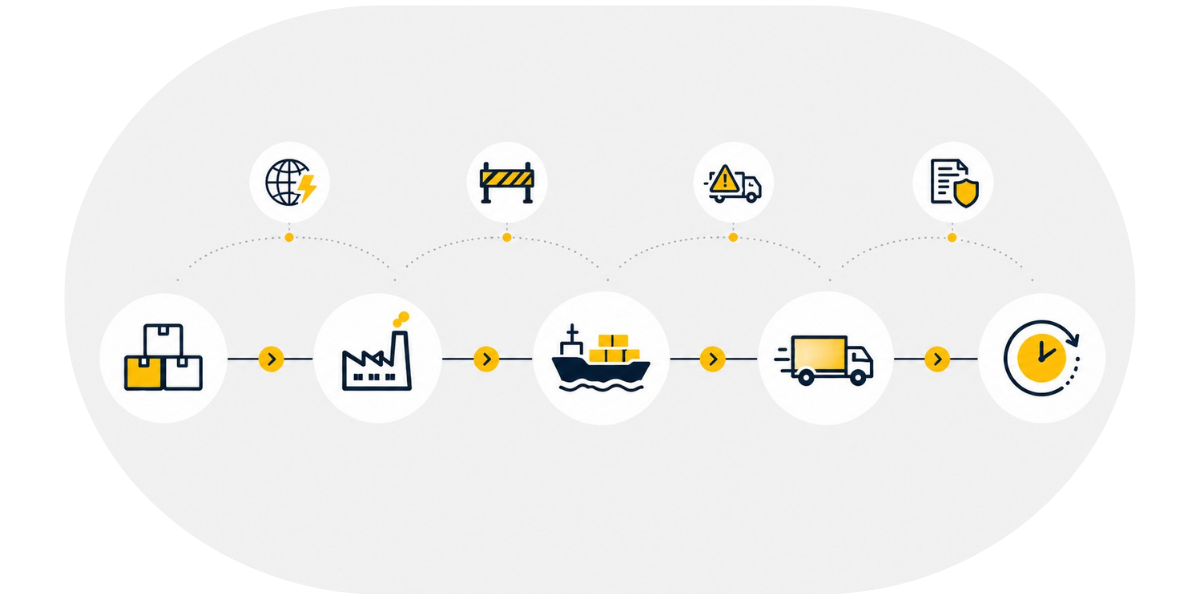
At the same time, disruption can originate much closer to the customer. A promotion can outperform expectations. Local demand can suddenly change. A product can trend on TikTok without the retailer having anything to do with the campaign. The cause varies, but the operational question remains the same: what can you do when the assumptions behind your plan are suddenly wrong?
This matters because availability is directly connected to the customer experience. As we discussed in our previous article on omnichannel availability, customers expect products shown as available to actually be available. Omnichannel experiences therefore depend heavily on accurate inventory information, forecasting and allocation across locations and channels.
When disruption hits, those capabilities become even more important. If a supplier is delayed, the immediate question becomes how to make better use of the inventory already available. A retailer might have too much stock in one store while another is approaching a stockout. Rebalancing inventory between stores, warehouses or regions can create additional availability without waiting for new supply to arrive. This requires visibility across the network but also processes that allow the business to act on that information quickly. The priority should be to find the best available way to continue delivering value to the customer, even when that means moving away from the original plan.
Resilience Starts Before the Disruption
It is tempting to think of resilience as something that becomes relevant when a problem occurs. In practice, much of it is built during normal operations. Organizations that regularly challenge their supply chain processes also build a better understanding of how their systems behave under pressure. This can be as practical as learning which parameters can be adjusted when demand spikes, where planning constraints start to appear, or how far existing processes can be pushed.
Peak periods such as Black Friday, Christmas or major campaigns can therefore serve as valuable learning opportunities. By testing the limits of the setup during expected peaks, teams become more familiar with the levers available to them when an unexpected disruption occurs.
Another way to develop that understanding is through scenario-based planning and stress testing. What happens if one of your major suppliers cannot deliver? What happens if lead times suddenly double? What happens if demand for a category rises significantly above forecast? Rather than waiting for these scenarios to become real, organizations can simulate them, test how their systems and processes respond, identify gaps and improve their setup in advance.
This capability is far from universal. Gartner reported in 2025 that only 19% of surveyed supply chain organizations fully integrated scenario planning into their supply chain strategies.

Scenario planning gives the organization a chance to practice adaptation before it has to respond under real pressure. Think of it as training. The more familiar your organization is with adjusting parameters, evaluating alternatives and changing established flows, the less it has to learn while a real disruption is unfolding.
In our experience, resilience tends to grow through continuous improvement. Organizations that regularly challenge their forecasts, processes and system setup build knowledge about what works, where the constraints are and which alternatives are available. Waiting until a major disruption exposes those limitations leaves much less room to experiment. Continuous development creates that room before it is urgently needed.
Efficiency Can Strengthen Resilience
Efficiency and resilience are sometimes positioned as opposites. Efficiency is associated with lean operations and optimization, while resilience is associated with redundancy and buffers. But operational efficiency can also strengthen resilience. When routine supply chain processes are automated and reliable, teams have more capacity to focus on what has actually changed.
This connects directly to the exception-driven supply chain approach we have discussed previously. Instead of planners reviewing every product and every decision manually, systems can handle routine planning and highlight the relatively small number of exceptions that require attention.
This becomes particularly valuable during disruption. Imagine that unexpected demand means a group of products is now projected to stock out. The important question is not whether planners can manually review the entire assortment quickly enough. It is whether the system can identify the affected products immediately and give planners the information they need to act.
Agentic AI can take this further. Rather than simply flagging an exception, AI agents can analyze what caused it, evaluate possible responses and recommend or, where appropriate, initiate the next step. This allows planners to spend less time finding and investigating issues, and more time on the exceptions that genuinely require human judgement. When conditions change unexpectedly, that ability to move fast from detection to decision and action can make the supply chain more resilient.
Five Ways to Build a More Resilient Supply Chain
So how can businesses strengthen resilience before the next disruption arrives?
1. Build the ability to identify change quickly
You cannot respond to a problem you cannot see. Connected data, accurate inventory information and visibility across the supply chain make it easier to recognize when reality begins to deviate from the plan. That foundation starts with structured, reliable and consistent data. With strong data quality you can apply smart tools to automatically detect meaningful changes for teams to act on immediately.
2. Focus people on exceptions
Planners should not have to spend their days validating decisions that a system can make reliably. Automating routine processes and moving toward exception-driven planning allows human expertise to be concentrated where judgment is actually needed. During disruption, this becomes especially valuable. Instead of searching for problems, planners can focus on understanding and solving the exceptions with the greatest business impact.
3. Invest in people, not only systems
Supply chain resilience is also organizational resilience. If critical knowledge about a planning system or process sits with one person, that person becomes a potential bottleneck. Building broader competence across the team reduces dependency on individual specialists and increases the organization's ability to solve unfamiliar problems. Continuous education matters for another reason too: technology is changing quickly. Teams that understand both their business processes and the capabilities of their systems are better positioned to recognize new opportunities and adapt how they work.
4. Keep optimizing and testing
Do not wait for a major pain point before improving your supply chain. Continuously challenge your processes and systems. Test scenarios. Explore new forecasting capabilities. Automate processes that no longer require manual intervention. Identify where the current setup reaches its limits. The objective is not to create a perfect system. It is to know your system well enough to understand what you can do when conditions change.
5. Use standard processes where they make sense
Customization can create value when a process is genuinely differentiating. But unnecessary customization can also create dependencies and make change harder. Standardized processes based on established best practices are often easier to maintain, develop and adapt. They also allow businesses to benefit more quickly from new functionality and lessons learned across a broader community and technology ecosystem.
Resilience Is a Capability, Not a Project
Preparing for every possible disruption is unrealistic. A more useful ambition is to build the capabilities needed to respond when circumstances change. The businesses best prepared for uncertainty will be those that continuously improve how they operate: building reliable data foundations, automating routine decisions, testing their systems, developing their people and creating enough flexibility to act when circumstances change.
When supply or demand shifts unexpectedly, the quality of the original plan only takes you so far. What matters next is how quickly the business recognizes the change, evaluates its options and acts. That is what makes a supply chain resilient.